When Marketing Content and RevOps KPIs Are Misaligned
Marketing content can look like it’s working while revenue quietly disagrees. Traffic goes up. Leads flow in. And yet, pipeline quality feels off and RevOps keeps raising flags. This isn’t a failure of effort or talent—it’s what happens when content is optimized for attention while revenue is accountable for intent. This piece walks through where that misalignment actually comes from, and how post-PMF SaaS teams can design content that supports real buying moments instead of just filling the funnel.
When Marketing Content and RevOps KPIs Are Misaligned
Let me start with a situation you’ve probably lived through.
Marketing is doing the work. Content is shipping. Traffic is steady. Leads are coming in. On paper, things look… fine.
And yet, every time revenue comes up, the room gets a little quieter.
Sales doesn’t quite trust the leads. RevOps keeps flagging “quality issues.” Marketing feels like they’re being judged on outcomes they don’t fully control.
No one says it outright, but you can feel it: something’s off.
What makes this tricky is that no one is wrong. The system just isn’t lined up.

The Quiet Tension Between “Working” and “Helping Revenue”
Here’s the contradiction most post-PMF SaaS teams sit with, whether they name it or not:
Marketing content is performing. Revenue efficiency isn’t improving at the same pace.
You’ve probably had some version of this conversation:
- Marketing points to traffic, engagement, MQLs.
- RevOps points to pipeline quality, stalled deals, and forecast risk.
- Both sides have data.
- Neither side feels heard.
This is usually where teams default to debates about attribution. That’s rarely where the real problem is.
The deeper issue is simpler — and harder to fix:
Marketing is often optimizing for attention. RevOps is accountable for intent.
Those two only overlap some of the time.
How Content Metrics and Revenue Metrics Slowly Drift Apart
Early on, this gap doesn’t hurt much.
When you’re closer to PMF:
- Any demand feels like good demand
- Sales cycles are shorter
- Buyers are forgiving
But as you scale, a few things change — and this is where the misalignment starts to show.
First, the buyer stops being one person
You’re no longer convincing a single motivated user.
You’re dealing with:
- Someone who wants the tool
- Someone who controls budget
- Someone who worries about risk
- Someone who just doesn’t want surprises
Content that attracts interest doesn’t automatically help that group align internally.
Second, the sales motion slows down
More stakeholders means more questions. More questions mean more friction.
This is usually the point where high-volume content keeps “working” but mostly at the top of the funnel.
Third, RevOps shifts roles
RevOps stops being a support function and starts being a constraint.
Not because they’re difficult, but because efficiency suddenly matters.
So when content brings in volume without shaping downstream behavior, RevOps pushes back. Not emotionally. Structurally.
Where SaaS Marketing KPIs Start to Mislead You
This is a subtle thing, and it’s easy to miss.
Most SaaS marketing KPIs answer questions like:
- Did someone click?
- Did they convert?
- Did they engage at all?
They don’t answer:
- Did this help a deal move?
- Did it remove doubt?
- Did it make Sales’ job easier?
That’s how you end up with:
- Blog posts that rank but never show up in sales calls
- Case studies no one actually sends
- Assets that get downloaded and then disappear
When that happens, RevOps doesn’t say, “This content is bad.”
They say, “This isn’t helping the pipeline.”
Different language. Same frustration.
Reframing the Conversation: Pipeline-Focused Content
This is usually where I pause with teams and ask a different question:
Not “Is this content performing?” But “Where does this content matter in a real deal?”
Once you ask that, things get clearer.
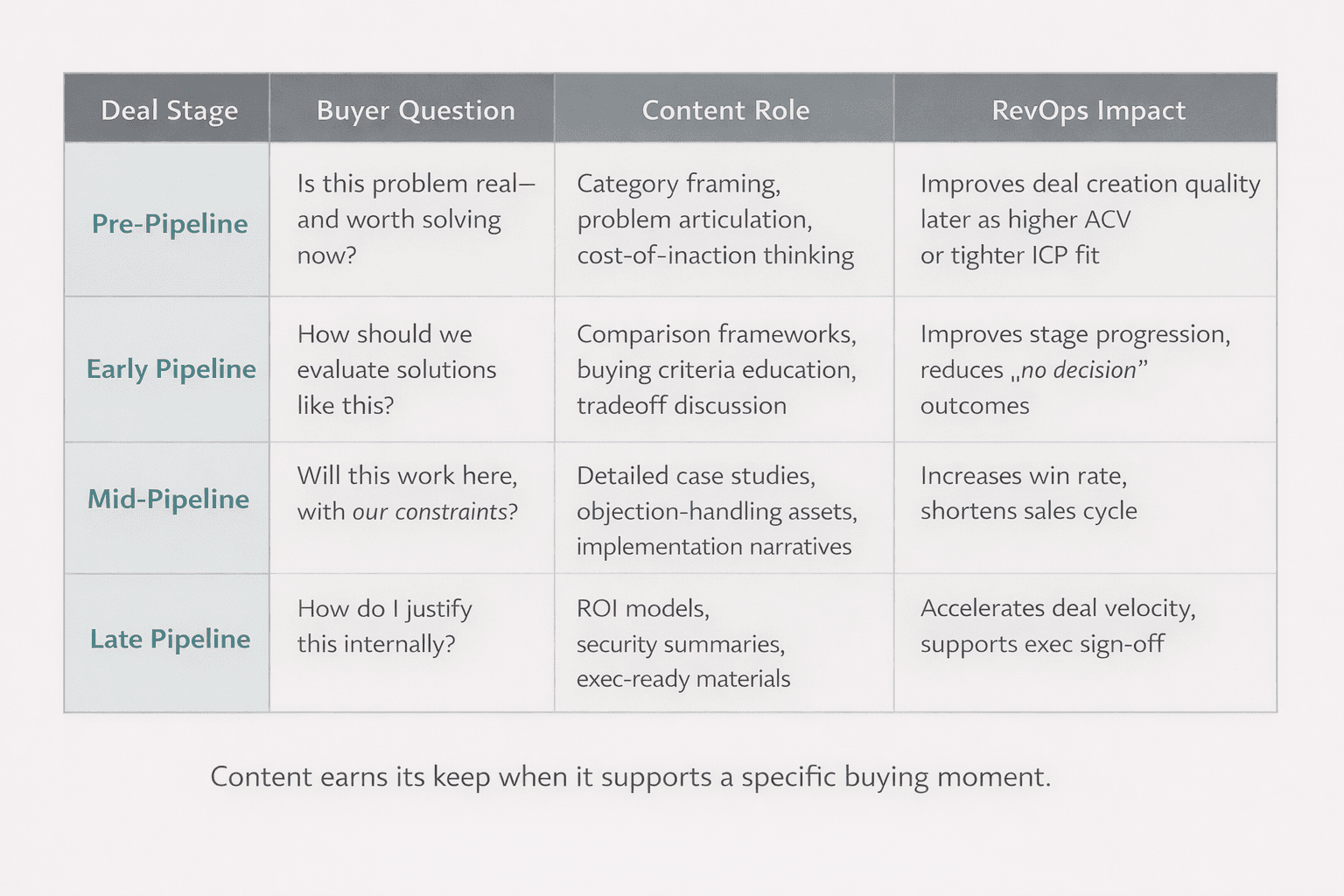
Before pipeline: problem clarity
This is where content helps buyers say, “Yes, this problem is real — and yes, we should act.”
RevOps won’t see immediate impact here. That’s okay. The value shows up later as better-fit deals.
Early pipeline: evaluation framing
This is where content quietly shapes how buyers compare options.
Not features. Tradeoffs.
When this works, Sales spends less time re-educating.
Mid-pipeline: risk reduction
This is where deals usually wobble.
Buyers aren’t asking, “Is this cool?” They’re asking, “Will this break something internally?”
Good content here reduces fear. RevOps feels that as cleaner stage movement.
Late pipeline: internal selling
This is where content stops being “marketing” and becomes ammo.
ROI explanations. Exec summaries. Security clarity.
When this content is missing, deals stall for reasons no one can quite explain.
What RevOps Actually Wants (Even If They Don’t Say It)
In my experience, RevOps isn’t anti-content.
They’re anti-surprises.
They want:
- Fewer deals that look good early and fall apart late
- Fewer leads that clog the system
- More predictability
Content helps when it:
- Answers hard questions early
- Aligns buyer expectations with reality
- Creates consistency across teams
At that point, RevOps stops seeing content as noise and starts seeing it as infrastructure.
Where Teams Usually Get Stuck
This is the pattern I see over and over.
Marketing plans content based on:
- Keywords
- Audience interest
- Competitive gaps
RevOps evaluates outcomes based on:
- CRM data
- Deal behavior
- Forecast accuracy
Both are reasonable. They’re just operating on different timelines.
Marketing feels pressure this quarter. RevOps feels pressure next quarter.
Alignment doesn’t come from another sync. It comes from agreeing on what success looks like across the whole deal.
Three Practical Adjustments That Actually Help
Nothing dramatic. Just things that tend to work.
1. Track content by deal stage influence
Not just “sourced pipeline.”
Ask:
- What content shows up in closed-won deals?
- Who uses it?
- When?
That question alone changes how content is created.
2. Let RevOps inform content briefs
Not approve. Inform.
Where are deals slowing? What objections repeat? What stage leaks worry you?
That input is gold — and usually underused.
3. Be willing to retire content
This is uncomfortable, but necessary.
If something:
- Pulls the wrong ICP
- Never appears in deals
- Increases sales friction
It’s not sacred.
At this stage, efficiency beats volume.
SEO Still Matters Just Not First
Yes, this should rank. Yes, keywords matter.
Use them naturally:
- Title & opening: RevOps and marketing alignment, content metrics vs revenue metrics
- Subheads: SaaS marketing KPIs problems, RevOps content strategy
- Conclusion: pipeline-focused content
But search visibility is the entry point not the outcome.
One Last Thought
When marketing content and RevOps KPIs are misaligned, it’s rarely because someone dropped the ball.
It’s usually because the system was designed in pieces.
Metrics in one room. Content in another. Revenue showing up later.
The fix isn’t louder content or tighter reporting.
It’s designing content with the deal, and the buyer, fully in mind.
Once you do that, the tension doesn’t disappear. But it becomes productive.
And honestly, that’s usually enough.
Written by Eliud Mbugua
Content Marketing Strategist & Writer | Helping Tech Founders Communicate Value & Attract Ideal Customers